Sunday, June 10, 2007

To See My Mother


Nero, also known as Little Black Cat, or Trouble, or Miss Query, or Shred-it, will be holding the fort and keeping my books warm. As the most petite of our four cats, she is, of course, Alpha Cat. She likes to hang out on my shoulder while I'm doing dishes (with claws like fishhooks) and sneak into boxes to shred papers.

I'm going to be away for a couple of weeks, visiting my mother and the country of my heart. The country will soothe me, I hope (if not too many vacation-home McMansions have been built in the last year), to counteract the unfortunate fact that my mother will drive me wild.

Mothers ... when someone said that there are only seven plots in the world, I think they forgot to mention that mothers are an entire genre unto their own. My own mother is currently eccentric, brilliant, sometimes a little silly, a hypochondriac, a beautiful writer, a visionary (in that she can "see" the world with the clarity of a Buddha), a guitar and piano player, an artist. She calls herself the Mad Duchess and is working on a musical about the evil benzene ring of oil. All this is an improvement over what she was for most of my life, especially when I was little and always scared of her.

A woman of genius, all her friends knew, and still do. A woman of violence and temper and never-quenched needs for love and affirmation (and financial support), few ever discovered. Those who did, scat. Except for my father, who had his own weak personality and a thwarted view that he had caused her madness; and of course except her children, who had no choice.

My mother was also the one who told me as I was leaving for college, "I hope I've taught you that science and practical disciplines aren't the only areas worth studying." Art matters. Her concern just baffled me, because art -- whether writing, painting, crafts, or reading -- was always dominant in our household. Indeed, despite an innate love for science and mathematics (inherited from my father's side), I went to university seriously crippled in my ability to study them. Everything in my life had always been abstract. What mattered was art. What defined my day-to-day life was my mother's constant redefining of reality to suit what she needed at the moment.

As a little girl, I was always frightened of my mother. Later, I was always angry at her. Now, her frozen inability to take any responsibility for her life frustrates me to no end, especially as it requires hefty financial support from those who have none to spare, and takes an emotional and mental toll on me that I could do without.

Her friends, and even her husband, know little of the personality underneath. They see only her brilliance, and speak, hinting, of the need for her art to be supported (her novel, her musical, her songs). Yes, true, but they are unaware of 30 years of uninhibited support, where every resource poured into her and she did nothing with it but to ask for more. One of the reasons I can't live anywhere near my mother is that my own hesitant pursuit of writing would crumble completely under the proximity to and weight of her needs.

And yet, there is nobody who understands or supports my pursuits like my mother does. Selfish, self-absorbed, needy, draining she may be, but she stimulates my mind in ways no other can. And when my confidence falters (as it does daily), it is her words of "this is most important -- all the other reality is veiling of truth" that make me lift my chin and keep going.

My mother taught me that messiness was good. And not just by letting me paint whatever I felt like as a child (pictures, stencils, walls, furniture ...). A messy life makes you look at the world from odd angles. It makes you see things others don't, and in ways others never can.

This is why I've never attempted to publish my memoir about my mother, my childhood. I haven't yet gotten to the point where I can brushstroke the strengths through the pain and rage and violence and fear. It is not enough to say, "My mother made me appreciate creativity." It will take years before I can wrap my head around, and appreciate, and write about fairly, the worldview she gave me.

Friday, June 8, 2007


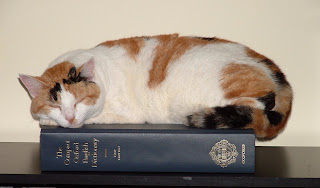
This is Nemo. She keeps me company while I rifle through reference books thinking of posts and responses to others' posts at the new blog on grammar and language, The Chocolate Interrobang. The Compact Oxford English Dictionary makes a great cat bed.

Wednesday, June 6, 2007

Hands off my belly!

It's happened -- the thing I always dreaded most and was forewarned about. My belly has been rubbed without my permission.

It was a friend, a tiny-boned, lithe little Frenchwoman I used to take yoga from. I've tried to detach from her recently because I discovered that she's one of these new-agey health people who started giving far too personal advice about my husband's physical health (there's nothing wrong with him) and my mental and emotional life. She tried to drag me to a meditation class run by a woman who does past life regression. I can't stand that kind of thing. And this weekend, while we hung out at the organic farm (the little hide-out for the few liberals in my area), she rubbed my belly while lecturing me about a book I absolutely have to read on Parageneology. Work that one out.

There is another woman in my regular yoga class who I know would love to feel up my little sproglet, but is too polite to ask. I'm grateful to her.

One thing that made me so ambivalent at the beginning of my pregnancy was the knowledge that the single most private thing in my life, what was going on in my body, was something that the whole world would soon be able to see and comment on. For an introvert, a very private person, it was a horrific prospect.

I'm trying to steel myself to it. To anyone who doesn't know I'm pregnant, I can still hide it if I want (almost six months and I've only gained three pounds?). I live in a place where people tend to thickness, if not chubbiness. And I've started not to mind if strangers do notice and comment, as long as they refrain from telling me how I'm feeling and what I should be doing.

What strikes me as funny is how being pregnant, especially visibly so, has further solidified my position on abortion. (Side note: this position is something I'm going to write about soon, as it's going through some evolutions through experiencing a wanted pregnancy.) My body, my sproglet, me. Hands off me.

Monday, June 4, 2007

Talked out of the bookstore

I've been drummed out of Barnes & Noble. The drumming was performed by a chatty man who wanted to tell me all about his difficult decision about should-he-go-for-a-new-job, and what to do about his weekend beach house, and ...

But I was sitting placidly in a chair, working on an essay, and listening to my little music. My B & N has a second floor with all these huge, cushy chairs clumped in groups of 4 around coffee tables. It's a great place to work or read or nap. I do all of the above.

Or did. This is the third time a random man has started to jabber jabber at me about all sorts of things in his life. My husband thinks they're hitting on me, but they're not. There must be something in my aura that yelps, "Open for business!" It's happened all my life.

The time before that it was a Russian emigre, who lectured me about American food, American lifestyles, how Americans are so dirty and don't know how to cook. That happens all the time, too, people deciding I'm just the individual to try out their fix-the-world ideas on.

But this man went too far. Just over the edge. Can't say how I can tell, just can. And he trampled right all over my delicate introvert sensibilities. He kept interrupting my work (I cannot write if I think someone's going to talk to me at any moment--if I have houseguests, my writing life disappears). He asked for my email address.

He asked where I was from. I told him (heaven help me, I can't lie), and privately choked a moment at the physical grip the Rockies still have on me. God, I miss home. He said, "That's why you're so nice." I thought (sometimes wish I'd said), "No, where I'm from people respond politely when interrupted in a coffee shop because where I'm from the interruptor knows to go away."

A few days later I risked Barnes & Noble again. I hid at a table, away from the cushy chairs, near the used book section. An hour later, he found me, grinned, pulled a chair out as I reluctantly removed my earphones (I can only listen to one of 3 CDs when writing, and bookstores don't play them).

He jabbered. I shrank. Now I can't go back. I'm stuck at home, with so many distractions, like a computer with Internet access. Why why why! In the spirit of Jonathan Rauch, "How interesting. Now please shush."

Monday, April 30, 2007

The Pre-Victorian Blogger

For my birthday yesterday I received a delightful book called Voices from the World of Jane Austen. Among all the authors that I have loved and revered and indulged in, Jane Austen remains the constant favorite for her irrepressible wit and social commentary, heightened by conflicting sometimes with her heartfelt desire to be a moral, just, and good.

I knew, of course, that a woman such as Austen -- in her social position and period -- would have spent a great deal of time writing letters. It was the only mode of communication for people who did not have the money to travel far or frequently, and Austen had a large and scattered family. I read a passage last night that described her and her favorite sister Cassandra corresponding every single day if they were in different places, and I wondered idly of what they wrote about. Bits of Jane's humor infuse her letters, her ability to see the absurdities of others people, but that is the character of the letters. Their content is of course what you'd expect: clothes, social engagements, daily activities, progress on the piano or with a book, changes in fashion, family news ... in short, the very thing that blogs today are made of.

I am new to the blogging world, and have been discovering many excellent blogs (which I prefer to call columns or journals or even diaries in the very old-fashioned sense of the word) and some very tedious ones. It amazes me that people get up every day to tell their friends and strangers the minutia of their lives--activities, thoughts, interactions, trials, annoyances, hobbies, and discoveries--in short, the very things that letter-writers in the pre-telephone age might have composed on a daily basis.

I needn't even go so far back. I think one of the reasons I decided to start a blog is that all my pen-and-paper correspondents have fallen by the wayside. Ten years ago, when I moved overseas, when the Internet was less accessible and the telephone prohibitively pricey, probably my favorite activity was sitting in a coffee shop with blank paper and a nice, fat letter to respond to. I loved writing letters. I still do, in fact. But all my friends gradually stopped responding, many of them switching to email and some disappearing altogether.

For some reason email can't fully replace the sweep of ink across the page for me. My entire tone is different when I write an email, my thoughts less profound and my observations more shallow. The contact is certainly fleeting in a way that it wasn't when I and a correspondent made a commitment to set aside time to write a letter and put a stamp on an envelope. I miss it.

A blog isn't the perfect medium for me, either, but it allows a freedom that isn't entirely accessible when writing a different email to every person I happen to correspond with. Most of my few entries I have, in fact, started with pen to paper, as I do most of my writing. And, given the lack of people who would ever write letters back to me if I sent them, a blog is an ideal medium for an introvert, where I can muse without engaging in the high-strung jumpiness of modern social contact.

It's nice to think, though, that Jane Austen, despite all she would have deplored in modern life, would probably have adapted to and delighted in this outlet for thought, creativity, and contact with the world both near and far.

Sunday, April 29, 2007

Despairing of Hope

I spend much more time than I should reading the reader letters on Salon.com, especially those in response to Glenn Greenwald's matchless daily column on the Constitution, government, and the media (incidentally, why do we still call it a blog when it has obviously become something more--why is it not a "column"? just a question of semantics). The most recent post and discussion has to do with a watershed moment in recent American history, when it seems that the country is beginning to wake up to the appalling lawbreaking and immorality of the Bush Administration.

While I do have some hope on the fronts of real freedom and the defense of the Constitution, I cannot join in with even tentative hope for the future of this country and the world. I might get lynched for this, but my heart is less wrapped up in freedom of speech than it is in the physical future of the land that I love. And I'm not talking about global warming.

Today is my birthday. I planned on going for a hike, but it's raining, so I sat in bed having late tea and writing, which I do frequently. And I found myself thinking of this recent Salon discussion, feeling around in my own heart for symptoms of hope, and suddenly dissolving into tears. No, it's not just pregnancy hormones.

My solace -- practically my religion -- for my entire life has been escape into nature, especially the wilderness of my home in the Rockies. It has always been my only real release from the pressures of life, although I find it harder to penetrate in the East Coast's sticky, oppressive summers.

But fresh, clean air and water, and unhindered views are fast disappearing. There will no longer be any solace in them for me. Which brings me every day, I'm afraid, to question the purpose of my existence. All I truly care about is nature. All I truly love and believe in is wilderness. And this one thing, the thing that makes life worth living to me, is the one thing the rest of the world sees as completely expendable, as having no worth in itself. Why do I live if what I care for is the only thing that the world refuses to protect or value?

Every day that question weighs upon me. There are many other things to live for and enjoy, I know, but this is the deepest thing, the one thing that my heart cannot let go of, the loss of which I will never stop mourning. And I despair in a life that says I have to fight for it, never enjoy it, never just take daily pleasure in it. I have to fight to preserve just a little of it, all the while knowing that the fight is, in the end, already lost. The pressures and greed of humanity will always take precedence over that which can only be lost, never found or created again. My heart -- my very spirit -- shrivels in that knowledge.

I don't want to live like this. Not that I want to not live, but existence without recourse to wilderness is, to me, absolutely bleak. Some year soon enough I will no longer be able to walk in any untouched land without the hum and roar of ATVs and snowmobiles intruding on me, or without the constant conscious threat of coal mining and the demands of rapacious development.

I don't want a planet like this. Our freedoms, our Constitution, our self-respect, these things we can fight for and win back, but a landscape once destroyed will always be scarred, and wilderness once taken away can never, ever be truly regained.

What hope is there in this prospect? How can I raise my children with the values of husbandry and stewardship that were instilled in me, when I can see that I would be raising them only to have their hearts broken? Those who deeply, burningly love the land are too few to fight against those who say that the rights not just of human survival, but of unencumbered human property come first.

Until I can walk into the wilderness and know that nobody is secretly planning to drill oil wells in it, or level its mountains and poison its water for coal mining, I will not feel hope. And right now, as the country is waking up a little to political horrors, it is hurriedly pushing tens if not hundreds of brand-new coal-burning plants whose fuel extraction will utterly destroy the land of my heart. And the demands of a generation with money to spare are building gated mini-estates in hills I once walked freely. Their huge houses are like a swaggering, overweight man with a belt barely cinched below his paunch. They grin as their views give them the illusion of lordship, but they know nothing of the land they seek to own, or how to love it.

So no, I do not yet have hope. My faith is in something fragile and precious, something that others do not care for or understand, something too easily destroyed.

Thursday, April 26, 2007

A Bed of Red Flowers, Nelofer Pazira

I just finished reading one of my Christmas presents (my mother always sends me a huge pile of used books for every holiday) -- A Bed of Red Flowers, a memoir about Afghanistan by Nelofer Pazira. Pazira grew up largely in Kabul, and her family escaped first to Pakistan, then as refugees to Canada toward the end of the Soviet occupation of her home country.

The book started out slowly enough (despite the tale of the child Pazira visiting her father in prison) that I had serious doubts about whether it was going to be any good or not. Too many factual paragraphs about who was in charge and how they came to be there, too little narrative that kept my imagination with her. But I kept reading because I thought it would at least be educational, and the book, rather than keeping up a tedious tone, suddenly opened out into a real story -- a childhood of love, fear, anger, repression, countrywide violence and war, and a simmering resentment against Afghanistan's occupiers, Soviet soldiers.

Pazira grew up hating the Soviet Union and anything to do with Russia. She watched Soviet tanks rumble through her streets and Soviet planes fly overhead, and the sight of them nurtured loathing, anger, and patriotism in her heart. From before she was ten years old, she had learned to love the mujahidin, the brave men who were fighting for her country's freedom from the hated occupiers. When she got older, she joined an underground resistance movement that supported the holy soldiers, fighting for liberation.

What's important about the book is not just the historical detail of the proxy war fought between the United States and the Soviet Union on the land of this tiny, poor country, but also the striking picture of modern Afghani life before the Taliban came to power. We in the West are used to knowing only what we see on television. So after the U.S. attacked Afghanistan, we were shown pictures of women in burkas and told they had no access to education or health care. What we weren't told is that, only ten years ago, before the U.S.-backed mujahidin came to power, women dressed 'normally' (including mini-skirts and make-up), and went to school just like the boys did. Pazira grew up in a modern Afghan culture that knew little of these ultra-repressive quasi-religious practices.

But she did grow up knowing the fear of attack and the rage of an occupied land. A point came when it was almost certain that Pazira's father and some other relatives would be arrested for suspicious activity, or perhaps suspicious thought. Her father, who had many times said he would never, ever abandon his country, finally, in weariness, agreed to her mother's begging that they leave. So they did, traveling with a smuggler to a refugee camp in Pakistan.

And it was here that Pazira's illusions about her heroes the mujahidin were crushed. Her very first day in refugee lodging, she peeked out a garden gate and was shot at -- not to injure, but to warn. "Never, ever go outside," said her frightened hostess. "If they see you without your hair covered, or without a man, they'll shoot at you." Pazira was enraged. In Kabul, she had gone to school, studied -- rebelled against memorizing Marx and learning Russian, sure, but her education was never limited because she was a woman -- and she had dressed as she pleased. Most important, she had believed in the holy war, the mujahidin, the people who, like her, loved her land and fought for it. And she found, in the end, that not only were they narrow, cruel people, but that they considered her a second-class citizen, hardly a person at all.

When she was growing up, says Pazira, "I was fascinated by the word 'mujahidin.' Because they were fighting the Russians, I supported them all, unconditionally. Now it appears that, like so many of my friends and classmates, I was staring at a looking glass. The mujahidin I believed in are no longer a reality. I'm beginning to see a different face of jihad."
Pazira learned about bickering warlords, about the U.S. backing and arming of some of the worst, most inhumane men fighting the Soviets. It was these people who later took over her country. After fleeing to Canada, she received infrequent letters from a friend still in Kabul. Even before the Taliban came to power, women were forced out of schools and hospitals, under severe head coverings, and into their homes. The warlords fought among one another and, just like the Soviets, killed the innocent people in between.

This is an important book, not for its literary quality, but for the delicacy with which it shows the force of two competing outside powers pulling a country to pieces. The Soviets tugged at one end of the rope, and the American-backed mujahidin at the other. Between them, they pulled a knot so tight that they left a country full of innocent people gasping for space to think, to breathe, to live. As the Soviets pushed themselves into Afghanistan, the other side took further refuge in more extreme religion, to mark themselves as truly holy warriors, and it they who the Americans supported almost unconditionally. In 2001, they pointed to the Taliban as evil enemies, but neglected to mention that it was the American government that armed these people, put them in power, and then turned a blind eye to their extreme religious oppression and moral corruption.

There are no easy answers in this book, except perhaps one. A friend of Pazira's, an older man, points out that, while historians try to make war a story of strategy, of battles won and battles lost, those facts are simply the window dressing, something to make sense of war. What war actually is, is destruction, despair, death, and the anger of those caught between -- a story of lives lost and destroyed, of a land ripped apart.